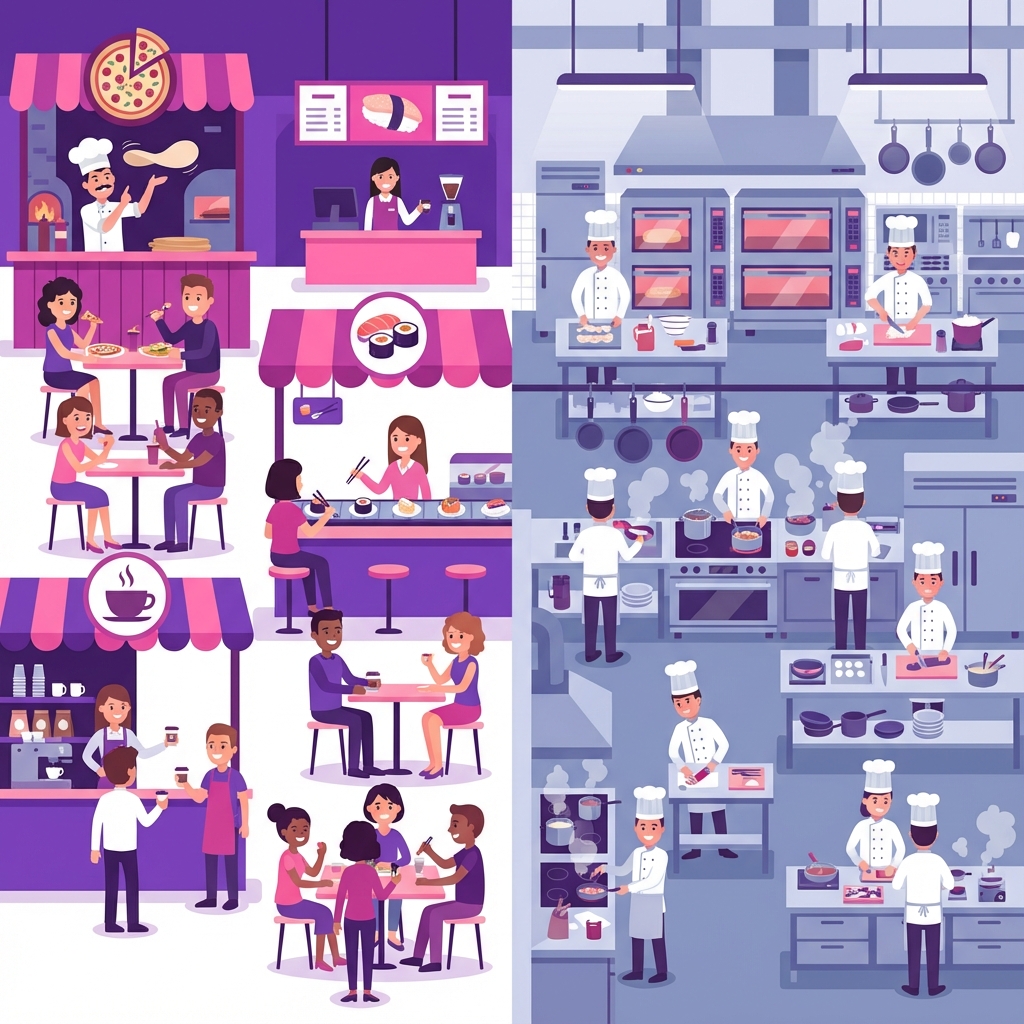
The Restaurant Analogy
Imagine two types of restaurants:
Traditional Restaurant (Monolithic): One huge kitchen where the head chef handles everything - appetizers, main courses, desserts, and drinks. If the chef gets overwhelmed or the pizza oven breaks, the entire restaurant slows down or shuts down.
Food Court (Microservices): Separate specialized stations - a pizza place, a sushi bar, a dessert shop, and a coffee stand. Each operates independently. If the pizza oven breaks, you can still get sushi, dessert, and coffee. Each station can expand or reduce staff based on demand.
That's microservices - breaking down a large application into smaller, independent services that work together.
What Are Microservices?
Microservices are an architectural style where an application is built as a collection of small, independent services. Each service:
- Does one specific job really well
- Can be developed and deployed independently
- Communicates with other services through simple APIs
- Can be built using different technologies
Monolithic vs Microservices
🏛️ Monolithic Architecture
Imagine a Swiss Army knife - everything is built into one tool:
- All code in one codebase
- Deploys as a single unit
- Shares one database
- Pros: Simple to develop initially, easy to test, straightforward deployment
- Cons: Hard to scale specific features, one bug can crash everything, difficult to update without affecting the whole system
🧩 Microservices Architecture
Like a toolbox with specialized tools:
- Multiple small codebases
- Each service deploys independently
- Each service can have its own database
- Pros: Scale individual services, use different tech for different needs, isolated failures, faster development
- Cons: More complex to set up, requires good coordination, network communication overhead
Real-World Example: E-Commerce Platform
Let's say you're building an online store like Amazon. In a microservices architecture, you might have:
- 🛍️ Product Catalog Service: Manages product listings, descriptions, images
- 🛒 Shopping Cart Service: Handles adding/removing items, calculating totals
- 💳 Payment Service: Processes credit cards, PayPal, etc.
- 📦 Shipping Service: Calculates shipping costs, tracks packages
- 👤 User Service: Manages accounts, profiles, authentication
- 📧 Notification Service: Sends emails, SMS, push notifications
- ⭐ Review Service: Handles product reviews and ratings
How They Communicate
Microservices talk to each other like people in different departments of a company:
📨 REST APIs
Like sending emails - Service A makes an HTTP request to Service B and waits for a response.
Cart Service → Payment Service: "Process this $99.99 payment"
Payment Service → Cart Service: "Payment successful! Transaction ID: 12345"
📢 Message Queues
Like leaving sticky notes on a bulletin board - Service A posts a message, Service B picks it up when ready.
Order Service: "New order #5678 created" (posted to queue)
Shipping Service: (picks up message) "I'll handle this order"
Benefits of Microservices
🚀 Independent Scaling
Scenario: Black Friday sale - shopping cart service is overwhelmed, but product catalog is fine.
- Monolithic: Must scale the entire application (expensive and wasteful)
- Microservices: Only scale the cart service (efficient and cost-effective)
🔧 Technology Flexibility
Different services can use different technologies:
- Product Catalog: Python (great for data processing)
- Payment Service: Java (enterprise-grade security)
- Notification Service: Node.js (handles many concurrent connections)
- Analytics: Go (high performance)
🛡️ Fault Isolation
If the review service crashes, customers can still browse products, add to cart, and checkout. Only the reviews are temporarily unavailable.
👥 Team Autonomy
Different teams can own different services:
- Payment team works on payment service
- Shipping team works on shipping service
- Teams don't step on each other's toes
- Faster development and deployment
⌛ Faster Updates
Update the recommendation algorithm without redeploying the entire application. Push changes to production multiple times a day if needed.
Challenges of Microservices
🧑💻 Increased Complexity
Instead of debugging one application, you're managing dozens of services, their interactions, and network issues.
📊 Monitoring & Debugging
Tracking a user request across 10 different services is like following a delivery package through multiple warehouses and trucks.
🔐 Security
More services mean more attack surfaces. Each service needs proper authentication and authorization.
👾 Data Consistency
When services have separate databases, keeping data in sync is challenging. If a payment succeeds but the order service fails, you need strategies to handle this.
When to Use Microservices
✅ Good fit when:
- Your application is large and complex
- You have multiple teams working on different features
- Different parts have very different scaling needs
- You need to use different technologies for different components
- You want to deploy features independently
❌ Not ideal when:
- You're building a small application
- Your team is small (under 10 people)
- You're just starting out and need to move fast
- You don't have DevOps expertise
Real Companies Using Microservices
- 🎬 Netflix: Runs over 1000 microservices to handle streaming, recommendations, billing, etc.
- 🛒 Uber: Uses microservices for rider matching, payments, maps, and more
- 📦 Amazon: Pioneered microservices - each team owns services from database to UI
- 🎵 Spotify: Microservices allow them to release new features multiple times per day
Supporting Technologies
- Docker: Packages each microservice into containers
- Kubernetes: Manages and orchestrates containers at scale
- API Gateways: Single entry point that routes requests to appropriate services
- Service Mesh: Handles service-to-service communication, security, and monitoring
The Bottom Line
Microservices are like moving from a one-person band to an orchestra. Each musician (service) specializes in their instrument and can practice independently, but they all play together to create beautiful music (a working application).
While microservices add complexity, they provide flexibility, scalability, and resilience that large, growing applications need. For small projects, a monolith is often simpler and better. But as your application and team grow, microservices become increasingly valuable.
The key is understanding your needs and choosing the right architecture for your situation, not just following trends.